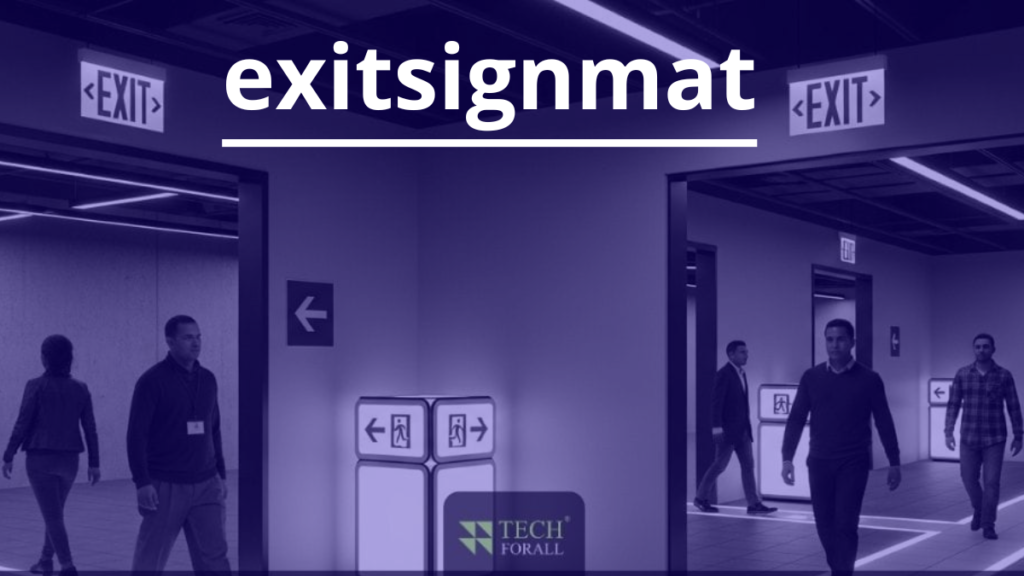

Emergency evacuation in modern buildings has become more complex due to increased population density, taller structures, and larger commercial spaces. In critical situations such as fire, smoke spread, or power failure, traditional signage systems often struggle to provide clear guidance. Visibility issues, panic, and confusion can significantly delay safe evacuation, making improved systems essential for saving lives and reducing injuries.
The concept of exitsignmat introduces a new way of guiding people during emergencies by shifting safety signals closer to the ground where visibility remains stronger even in smoke-filled environments. Unlike conventional exit signs mounted on walls or ceilings, this system focuses on floor-level guidance that remains visible when upper-level visibility is reduced. This innovation is gaining attention as a practical solution for modern building safety challenges.
What is exitsignmat and how it improves evacuation guidance systems
The exitsignmat is a modern emergency safety innovation designed to guide people toward exits using floor-level illuminated pathways. It is typically installed along corridors, hallways, stairwells, and exit routes. The purpose of this system is to ensure that even when smoke fills a room and blocks higher visibility areas, the escape path remains visible near the ground where air clarity is better.
In essence, exitsignmat acts as a continuous safety guide that directs individuals step by step toward safe exits. Unlike traditional signs that rely on eye-level visibility, this system leverages human instinct to look downward in low-visibility conditions. By providing consistent illumination or glow-based indicators, it reduces confusion and enhances evacuation speed, especially in high-risk environments such as commercial complexes and public buildings.
How exitsignmat works during fire and emergency situations
During emergencies, visibility becomes one of the most critical challenges for safe evacuation. The exitsignmat system works by providing illuminated or glow-in-the-dark pathways that remain visible even in dense smoke conditions. These systems are strategically placed along evacuation routes, ensuring that individuals can follow a clear path without needing to rely on overhead signage or verbal instructions.
The technology behind often includes LED lighting, photoluminescent materials, or battery-backed illumination systems. When normal lighting fails, these systems automatically activate or continue glowing, guiding people toward safety. In panic situations where visibility drops rapidly, this floor-level guidance becomes a crucial lifeline, helping reduce confusion and preventing crowd congestion near exits.
Key features that make exitsignmat a reliable safety system
One of the most important features of exitsignmat is its floor-level visibility design, which ensures that evacuation paths remain clear even in dense smoke. This low-positioned guidance system takes advantage of the natural behavior of people who tend to look downward when visibility is reduced. This makes it more effective than traditional overhead signage systems.
Another key feature is its durability and energy efficiency. Many systems are built with anti-slip materials and long-lasting illumination technology. They can operate using low power consumption systems or backup batteries, ensuring continuous operation during power failures. These features make the system highly reliable for both commercial and industrial environments where safety cannot be compromised.
Benefits of exitsignmat in improving building safety and evacuation efficiency
The exitsignmat system significantly improves evacuation speed by providing clear directional guidance during emergencies. When people can quickly identify a safe path, it reduces panic and minimizes hesitation. This leads to faster and more organized evacuation, which is essential in preventing injuries and ensuring survival in critical situations such as fires or structural emergencies.
Another major benefit of exitsignmat is its ability to support vulnerable individuals such as children, elderly people, and those with disabilities. In stressful situations, these groups often struggle the most with confusion and visibility issues. By offering clear floor-level guidance, the system ensures inclusivity and improves overall safety standards across different types of building occupants.
Applications of exitsignmat in commercial and public environments
The use of exitsignmat is becoming increasingly popular in commercial buildings such as shopping malls, office complexes, and entertainment centers. These environments often experience high foot traffic, making efficient evacuation systems extremely important. The floor-level guidance helps manage large crowds and directs them safely toward exits during emergencies.
In addition to commercial spaces, exitsignmat is also highly useful in hospitals, schools, hotels, and industrial facilities. In hospitals, it helps guide patients and staff during emergencies when quick evacuation is necessary. In schools and universities, it ensures that students can safely follow exit routes even in chaotic situations. Industrial environments benefit from its durability and ability to function under harsh conditions.
Comparison between exitsignmat and traditional exit sign systems
Traditional exit sign systems rely mainly on wall-mounted or ceiling-mounted indicators that may become less effective during smoke-filled emergencies. In contrast, exitsignmat provides floor-level guidance that remains visible even when upper visibility is blocked. This fundamental difference significantly improves evacuation efficiency in real-world emergency scenarios.
Another important difference lies in user behavior during emergencies. People tend to look upward in normal conditions but shift their focus downward when smoke reduces visibility. exitsignmat takes advantage of this behavior, offering a more natural and intuitive escape path. This makes it a more reliable option compared to conventional systems that may fail under extreme conditions.
Safety standards and compliance considerations for exitsignmat systems
Modern building safety regulations increasingly emphasize the importance of advanced evacuation systems. The exitsignmat aligns with these safety expectations by providing enhanced visibility and structured evacuation pathways. Many safety codes encourage the use of redundant systems that remain functional during power failures or fire emergencies, making this technology highly relevant.
Compliance with fire safety standards is crucial for commercial and public buildings. Systems like exitsignmat support compliance by improving evacuation efficiency and reducing risks associated with poor visibility. As safety regulations continue to evolve, more buildings are expected to adopt advanced floor-level guidance systems to meet future safety requirements.
Installation and maintenance process of exitsignmat systems
Installing exitsignmat requires strategic planning to ensure maximum visibility and effectiveness. The system is typically placed along primary evacuation routes, staircases, and exit corridors. Proper placement ensures that individuals can easily follow the path without confusion, even in stressful emergency situations where visibility is severely reduced.
Maintenance of exitsignmat systems is relatively simple but essential for long-term performance. Regular inspections are required to ensure that lighting components, batteries, or photoluminescent materials remain functional. Proper maintenance ensures that the system performs reliably during emergencies, which is critical for building safety management and risk reduction.
Future developments and innovations in exitsignmat technology
The future of exitsignmat is expected to include integration with smart building systems and IoT-based safety networks. This would allow emergency systems to automatically activate evacuation routes based on real-time hazard detection. Such advancements could further enhance safety by providing dynamic and adaptive evacuation guidance.
Artificial intelligence may also play a role in future exitsignmat developments. AI-driven systems could analyze crowd movement and optimize evacuation routes in real time. This would make emergency evacuation even more efficient, reducing congestion and improving survival outcomes in large-scale emergencies.
Conclusion on the importance of exitsignmat in modern safety systems
The exitsignmat represents a significant advancement in emergency evacuation technology by addressing the limitations of traditional signage systems. Its floor-level visibility, durability, and intelligent design make it a powerful tool for improving safety in modern buildings. As emergencies become more unpredictable, reliable guidance systems become increasingly important.
In conclusion, offers a practical and innovative solution for enhancing evacuation safety across various environments. Its ability to remain visible during critical conditions makes it an essential component of modern building safety strategies. As awareness grows, more facilities are expected to adopt this system to ensure safer evacuation outcomes.
FAQs About exitsignmat
What is exitsignmat used for?
exitsignmat is used to guide people safely toward emergency exits during situations like fire, smoke, or power failure by providing floor-level visual evacuation paths.
How does improve safety compared to traditional signs?
It improves safety by offering visibility at floor level, where smoke is less dense, making it easier for people to see evacuation routes during emergencies.
Is effective during power outages?
Yes, most systems use backup power, LEDs, or photoluminescent materials that continue to function even during power failures.
Where can be installed?
It can be installed in commercial buildings, hospitals, schools, hotels, warehouses, and any environment that requires structured evacuation routes.
Does require maintenance?
Yes, periodic maintenance is needed to ensure lighting systems, batteries, or glow materials remain effective and fully functional.
Can be used in small buildings?
Yes, it can be used in both small and large buildings to improve evacuation safety and visibility.
Is compliant with safety standards?
It supports modern fire safety expectations and can be integrated into compliance-focused building safety systems depending on regional regulations.