

The gaming laptop market in 2026 has become more advanced, competitive, and performance-driven than ever before. Modern users are no longer satisfied with basic specifications; instead, they demand powerful GPUs, faster processors, and smoother displays. TheLaptopAdviser Expert Gaming Guide 2026 helps simplify this complex market and guides users toward smarter purchasing decisions based on real performance needs and long-term value.
In today’s digital world, gaming laptops are not only for entertainment but also for content creation, streaming, and professional workloads. TheLaptopAdviser expert gaming insights focus on balancing performance, portability, and cooling efficiency. This guide is designed to help both beginners and advanced gamers understand what truly matters before investing in a high-performance machine.
This article will break down everything from performance components to display technology and cooling systems. The goal is to ensure readers can confidently choose the right device without confusion or marketing influence. By the end, users will understand how to select a gaming laptop that fits their budget, style, and gaming expectations.
Understanding Gaming Laptop Performance Essentials
thelaptopadviser expert gaming performance is mainly determined by the combination of GPU, CPU, RAM, and storage speed. The GPU is the most critical component because it directly affects frame rates and graphical quality in modern games. High-end NVIDIA RTX series graphics cards are commonly recommended for smooth gameplay and advanced rendering effects.
The CPU plays an equally important role in handling background processes, AI calculations, and multitasking during gameplay. A strong processor ensures that games run without lag, even when multiple applications are open. In addition, RAM capacity has become essential, with at least 16GB now considered standard for gaming laptops in 2026.
Storage technology also impacts gaming performance significantly. Solid-state drives (SSD) are much faster than traditional hard drives, allowing quicker game loading times and smoother system responsiveness. TheLaptopAdviser expert gaming analysis highlights that a balanced configuration of all components is necessary to achieve optimal performance in modern gaming environments.
Display Quality and Refresh Rate Explained
Display quality has become one of the most important features for gamers in 2026. High refresh rate screens provide smoother motion, reduced blur, and improved reaction times during gameplay. A 144Hz display is often considered the minimum standard for competitive gaming, while 240Hz and higher options are preferred by esports players.
Resolution also plays a key role in visual experience. Full HD is still widely used, but QHD and 4K displays are becoming more popular among premium gaming laptops. Higher resolution provides sharper images and more detailed environments, but it also requires stronger GPU performance to maintain smooth frame rates.
Another important factor is response time, which determines how quickly pixels change color. Lower response times reduce ghosting and input delay, improving gameplay accuracy. According to TheLaptopAdviser expert gaming insights, choosing the right combination of refresh rate, resolution, and response time is essential for achieving a truly immersive gaming experience.
Cooling Systems and Thermal Performance in Gaming Laptops
Cooling systems are one of the most overlooked yet critical aspects of gaming laptops. High-performance components generate significant heat, and without proper cooling, performance can drop drastically due to thermal throttling. Effective cooling ensures stable FPS and long-term hardware durability.
Modern gaming laptops use advanced cooling technologies such as vapor chamber cooling, multiple fan systems, and liquid metal thermal compounds. These innovations help distribute heat more efficiently and maintain consistent performance during long gaming sessions. However, improved cooling often results in increased fan noise, which is a common trade-off.
Proper usage also plays a role in thermal performance. Placing the laptop on a hard surface improves airflow and reduces overheating risks. TheLaptopAdviser Expert Gaming Guide 2026 emphasizes that thermal efficiency is just as important as raw power when selecting a gaming laptop for serious or professional use.
Top Gaming Laptop Brands Recommended by Experts
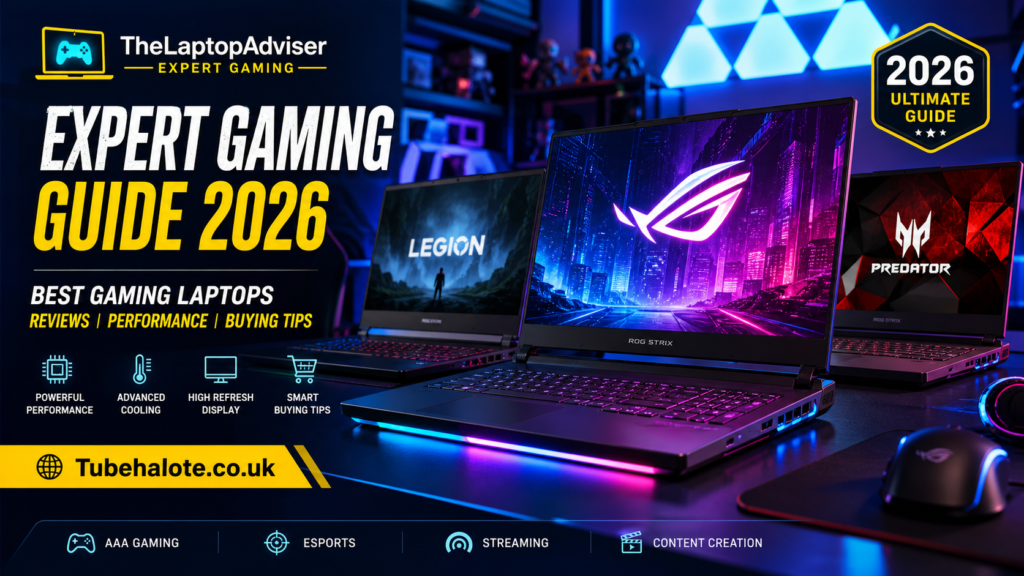
Several brands dominate the gaming laptop market due to their consistent performance and innovation. ASUS ROG series is widely recognized for its high-end gaming capabilities, offering powerful GPUs, strong cooling systems, and premium build quality.thelaptopadviser expert gaming These laptops are often chosen by professional gamers and streamers.
Lenovo Legion series is another strong competitor, known for its balanced performance and affordability. It offers excellent thermal management and reliable hardware configurations suitable for both casual and competitive gaming. Acer Predator laptops also provide strong performance at more budget-friendly price points.
Razer Blade laptops are considered premium options with sleek designs and high portability. Although they are expensive, they deliver excellent performance in a compact form factor. TheLaptopAdviser expert gaming analysis highlights that each brand serves a different type of gamer depending on performance needs and budget preferences.
Budget vs High-End Gaming Laptops
Budget gaming laptops are designed for casual gamers who want decent performance without spending too much money. These laptops usually include mid-range GPUs and CPUs that can handle popular games at medium settings. They are ideal for beginners or users who do not require ultra-high frame rates.
Mid-range gaming laptops offer a balance between performance and affordability. thelaptopadviser expert gaming They typically support high settings in most modern games and provide smoother gameplay experiences. These laptops are often the best value choice for most users who want strong performance without extreme pricing.
High-end gaming laptops are built for professional gamers, streamers, and content creators. They feature top-tier GPUs, advanced cooling systems, and premium displays. TheLaptopAdviser Expert Gaming Guide 2026 explains that choosing between budget and high-end models depends on usage needs, not just specifications.
Common Mistakes Gamers Should Avoid
Many buyers make mistakes when purchasing gaming laptops due to lack of research or marketing influence. One common mistake is focusing only on appearance and RGB lighting instead of actual performance specifications. While aesthetics are appealing, they do not improve gaming performance.
Another major mistake is ignoring thermal performance. Even powerful laptops can perform poorly if cooling systems are inefficient. Overheating leads to reduced performance and shorter hardware lifespan, which can be costly in the long run.
Users also often overlook upgrade options such as additional RAM or SSD slots. Choosing a laptop without upgrade flexibility can limit future performance improvements. TheLaptopAdviser expert gaming recommendations stress the importance of practical decision-making over visual appeal.
Expert Buying Tips from TheLaptopAdviser Gaming Guide
Choosing the right gaming laptop requires understanding your personal gaming needs. If you play competitive games, prioritizing high refresh rate displays and strong GPUs is essential. For casual gaming, balanced mid-range systems are often sufficient and more cost-effective.
Future-proofing is another important factor. Investing in slightly better specifications ensures the laptop remains relevant for several years. This includes selecting newer generation processors and GPUs that can handle upcoming game requirements.
Battery life and portability should also be considered. While gaming laptops are power-hungry devices, some models offer better efficiency for travel and daily use. TheLaptopAdviser expert gaming guide recommends evaluating overall value rather than focusing on a single specification.
Conclusion
The gaming laptop industry continues to evolve rapidly, offering users more power, better graphics, and improved portability. Understanding key components such as GPU performance, display quality, and cooling systems is essential for making the right decision. TheLaptopAdviser Expert Gaming Guide 2026 provides a complete framework for selecting the best device based on individual needs.
By following expert insights and avoiding common mistakes, users can invest in a gaming laptop that delivers long-term satisfaction and performance. Whether choosing a budget model or a high-end machine, balancing features with real-world usage is the key to success in modern gaming.
TheLaptopAdviser expert approach ensures that buyers focus on value, performance, and reliability instead of marketing hype. This leads to smarter decisions and better gaming experiences in the long run.
FAQs
What is the most important component in a thelaptopadviser expert gaming?
The GPU is the most important component because it directly affects gaming performance, thelaptopadviser expert gaming frame rates, and graphical quality. A powerful GPU ensures smooth gameplay in modern AAA titles.
How much RAM is recommended for gaming in 2026?
At least 16GB of RAM is recommended for gaming in 2026. However, 32GB is ideal for multitasking, streaming, and future-proof performance.
Is 144Hz enough for competitive gaming?
Yes, 144Hz is considered the minimum standard for competitive gaming. However, 240Hz displays provide even smoother motion and faster response times.
Do gaming laptops overheat easily?
Gaming laptops can overheat if cooling systems are not efficient or if airflow is blocked. Proper ventilation and advanced cooling technology help reduce overheating issues.
Which brand is best for gaming laptops?
ASUS ROG, Lenovo Legion, Acer Predator, and Razer Blade are among the top gaming laptop brands, each offering different strengths based on performance and budget.
Should I choose SSD or HDD for gaming?
SSD is strongly recommended because it provides faster loading times, smoother performance, and better overall system responsiveness compared to HDD.