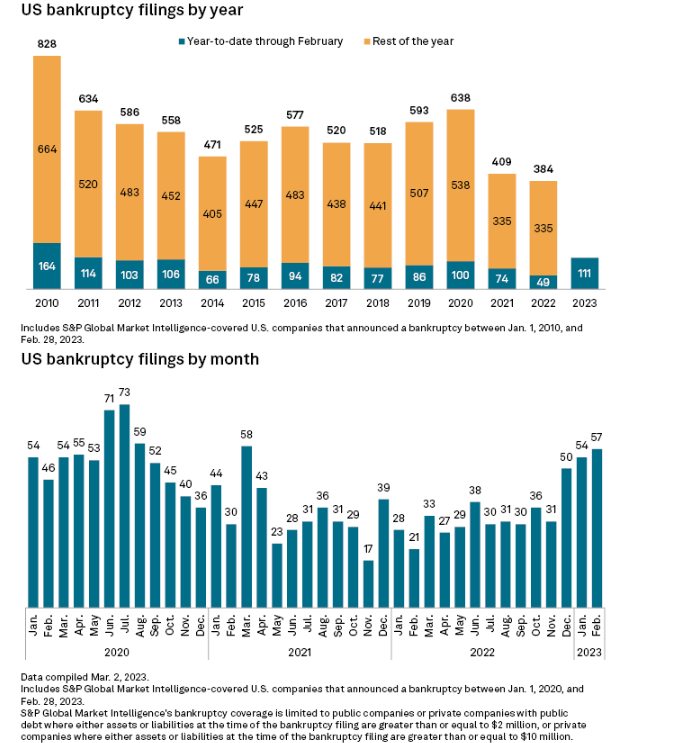

The year 2023 marked a significant turning point for corporate financial stability in the United States, as business failures increased at an alarming rate across multiple sectors. Rising interest rates, persistent inflation, and tighter lending conditions created an environment where many companies struggled to maintain liquidity. This situation led to a notable increase in financial distress across industries, making bankruptcy filings a key indicator of economic pressure.
According to industry tracking, the data compiled by s&p global market intelligence 2023 bankruptcy filings top industries shows that corporate distress was not limited to a single sector. Instead, it spread across consumer-driven markets, industrial operations, and finance-related businesses. The surge reflected deeper structural challenges in the economy, where both small and large enterprises faced rising operational costs and declining consumer demand.
Overview S&P Global Market Intelligence 2023 Bankruptcy Data
The analysis provided by S&P Global Market Intelligence revealed that 642 corporate bankruptcy filings occurred in the United States during 2023. This represented a 72.6 percent increase compared to the previous year, making it one of the highest annual totals in over a decade.s&p global market intelligence 2023 bankruptcy filings top industries The consistent rise throughout the year demonstrated that financial pressure was not temporary but part of a sustained economic trend.
Further insights from s&p global market intelligence 2023 bankruptcy filings top industries indicate that most companies opted for restructuring rather than liquidation. This trend highlights how businesses attempted to survive by reorganizing debt and operations instead of shutting down completely. The preference for restructuring reflects both legal flexibility and investor willingness to preserve value in struggling firms.
Top Industries Most Affected by Bankruptcy Filings in 2023
Consumer discretionary industries were among the most heavily affected sectors in 2023. Companies in retail, hospitality, and leisure struggled due to reduced consumer spending and increased debt obligations. Inflation reduced purchasing power, forcing many businesses to operate on thinner margins, ultimately leading to financial instability and bankruptcy filings across the sector.
Industrial companies also experienced significant pressure, as rising energy costs and supply chain disruptions increased production expenses. Many firms found it difficult to maintain profitability in a high-cost environment. The data from s&p global market intelligence 2023 bankruptcy filings top industries shows that industrials consistently ranked among the top contributors to overall bankruptcy totals.
Financial sector companies were also impacted, particularly those exposed to high-risk lending and credit services. As interest rates rose, loan defaults increased, affecting liquidity and balance sheets. Real estate and energy sectors showed similar stress patterns, although many firms in these industries opted for restructuring instead of full liquidation.
Economic Factors Behind the Surge in Bankruptcy Filings
One of the main drivers behind the 2023 bankruptcy surge was the rapid increase in interest rates. Higher borrowing costs placed significant pressure on companies with variable-rate debt, reducing their ability to refinance or expand operations.s&p global market intelligence 2023 bankruptcy filings top industries This financial strain contributed heavily to rising default risks across multiple sectors.
Inflation also played a critical role, increasing the cost of raw materials, labor, and logistics. Businesses that were already operating with thin margins found it increasingly difficult to absorb these costs. As highlighted in s&p global market intelligence 2023 bankruptcy filings top industries, inflationary pressure was a consistent factor affecting nearly every major industry group.
In addition, tightening credit conditions made it harder for companies to access new financing. Banks and financial institutions became more cautious in lending, especially to high-risk borrowers. Combined with slowing global demand, these factors created a challenging environment that pushed many companies toward bankruptcy protection.
Industry-wise Breakdown and Financial Stress Analysis
A deeper breakdown of bankruptcy data reveals clear patterns of financial stress across industries. Consumer-facing sectors showed the highest vulnerability due to their dependence on discretionary spending. When economic conditions tightened, these businesses experienced immediate revenue declines, making debt repayment increasingly difficult.
Small and mid-sized enterprises were particularly vulnerable, as they often lacked the financial reserves needed to survive prolonged economic pressure. According to s&p global market intelligence 2023 bankruptcy filings top industries, larger corporations also faced challenges, but many had access to restructuring options that allowed them to continue operations under revised financial structures.
Debt-heavy business models were another key factor contributing to financial distress. Companies that relied heavily on borrowed capital struggled the most when interest rates increased. This created a ripple effect across industries, where even stable companies became vulnerable due to external financial pressures.
Role of Restructuring in 2023 Bankruptcy Cases
Restructuring became the preferred path for many companies in 2023, as it offered a way to manage debt while continuing operations.s&p global market intelligence 2023 bankruptcy filings top industries Chapter 11 filings allowed businesses to renegotiate contracts, reduce liabilities, and reorganize their financial structure without completely shutting down.
This trend is clearly reflected in s&p global market intelligence 2023 bankruptcy filings top industries, where a significant percentage of companies chose restructuring over liquidation. This approach helped preserve jobs, maintain supplier relationships, and protect long-term business value.
The success of restructuring varied by industry. Companies with strong underlying business models were more likely to recover, while those facing structural decline struggled even after reorganization. However, restructuring still provided a critical lifeline for many firms navigating economic uncertainty.
Impact on the U.S. Economy
The rise in bankruptcy filings had a noticeable impact on the broader U.S. economy. Job losses increased in affected industries, particularly in retail, manufacturing, and construction. This contributed to rising unemployment concerns in certain regions, especially where industrial activity is a major economic driver.
Investor confidence also experienced fluctuations as corporate failures increased. Stock market volatility reflected concerns about corporate stability and future earnings potential. The data from s&p global market intelligence 2023 bankruptcy filings top industries further emphasized how widespread financial stress influenced market sentiment.
Credit markets tightened further as lenders became more cautious. This reduced access to capital for both struggling and stable companies, slowing down business expansion and investment activity. The overall economic environment became more conservative as risk levels increased.
Trends and Predictions Beyond 2023
Looking beyond 2023, analysts expect that bankruptcy trends may continue into 2024, although the pace may stabilize depending on economic conditions. Interest rate adjustments and inflation control will play a key role in determining future corporate stability.
Industries that remain heavily leveraged are expected to face continued pressure. However, companies that successfully restructured during 2023 may perform better moving forward. Insights from s&p global market intelligence 2023 bankruptcy filings top industries suggest that adaptability and financial discipline will be key survival factors.
Economic recovery, if supported by stable monetary policy, could reduce bankruptcy rates over time. However, structural challenges in certain industries may continue to drive isolated cases of financial distress.
Conclusion
The 2023 corporate bankruptcy surge in the United States reflects a complex combination of economic pressures, industry vulnerabilities, and financial restructuring challenges.s&p global market intelligence 2023 bankruptcy filings top industries Rising costs, high interest rates, and reduced consumer demand all contributed to widespread financial instability across multiple sectors.
The findings from s&p global market intelligence 2023 bankruptcy filings top industries clearly show that no single industry was immune to economic pressure. While restructuring provided relief for many companies, the overall trend highlights the importance of financial resilience in uncertain economic environments.
FAQs
What caused the increase in U.S. corporate bankruptcies in 2023?
The main causes included rising interest rates, inflation, and tighter credit conditions. These factors increased borrowing costs and reduced profitability across multiple industries, leading many companies into financial distress and bankruptcy filings.
Which industries were most affected by bankruptcy filings in 2023?
Consumer discretionary, industrials, financial services, real estate, and energy sectors were among the most affected. These industries faced high operational costs, reduced demand, and debt-related challenges throughout the year.
What does S&P Global Market Intelligence report about 2023 bankruptcies?
The report showed 642 corporate bankruptcy filings in the U.S.,s&p global market intelligence 2023 bankruptcy filings top industries marking a 13-year high. It also highlighted that most companies preferred restructuring over liquidation to preserve business value and operations.
Did most companies shut down or restructure in 2023?
Most companies opted for restructuring rather than liquidation. This allowed them to reorganize debt and continue operations while attempting to regain financial stability under court protection.
How did bankruptcy filings impact the U.S. economy?
Bankruptcy filings led to job losses, reduced investor confidence, and tighter credit markets. These effects slowed economic growth and increased financial uncertainty in several industries.s&p global market intelligence 2023 bankruptcy filings top industries
Will bankruptcy filings continue to rise in 2024?
Experts believe filings may continue but at a slower pace depending on interest rate changes and inflation control. Some industries may still face pressure due to structural financial weaknesses.s&p global market intelligence 2023 bankruptcy filings top industries
Why is S&P Global Market Intelligence data important?
It provides accurate and detailed tracking of corporate financial health, helping analysts understand industry trends, economic risks, and early warning signs of financial distress.
Which sectors showed the most restructuring activity?
Real estate and energy sectors showed high restructuring activity, with many companies choosing reorganization over liquidation to manage debt and continue operations.
you may also read
Kársperski Antivirus Review 2026: Features, Pricing Protection Guide Complete Analysis Expert Tested