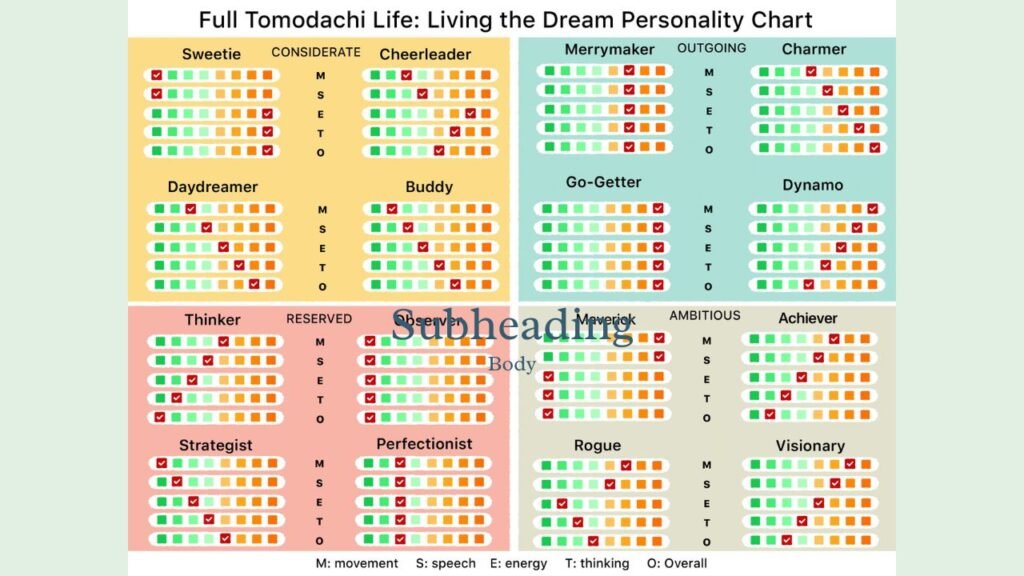

The Tomodachi Life personality chart shows the 16 personality types that can be assigned to your Mii characters in Tomodachi Life: Living the Dream. Each Mii belongs to one of four main personality groups: Considerate, Outgoing, Reserved, or Ambitious. The same groups may have different names in some regions, but the underlying personality types correspond to one another.
Your Mii’s personality is determined when you create the character by adjusting personality traits such as Movement, Speech, Energy, and Thinking. The Overall setting does not determine the core personality type.
For players trying to create a specific kind of Mii, the chart is useful because it lets you understand which personality group and type you are aiming for instead of choosing the sliders randomly.
Tomodachi Life Personality Chart at a Glance
There are 16 personality types, divided into four groups with four types in each group.
| Personality Group | US Name | UK/PAL Name | Personality Types |
|---|---|---|---|
| Considerate | Considerate | Easy-Going | Sweetie, Cheerleader, Buddy, Daydreamer |
| Outgoing | Outgoing | Energetic | Charmer, Go-Getter, Merrymaker, Dynamo |
| Reserved | Reserved | Reserved | Observer, Perfectionist, Strategist, Thinker |
| Ambitious | Ambitious | Confident | Achiever, Visionary, Rogue, Maverick |
The most important thing to remember is that regional names can differ. For example, the US version uses names such as Sweetie, Buddy, and Achiever, while other versions may use names such as Softie, Carer, and Busy Bee. These differences do not mean they are separate personality systems.
How the Tomodachi Life Personality Chart Works
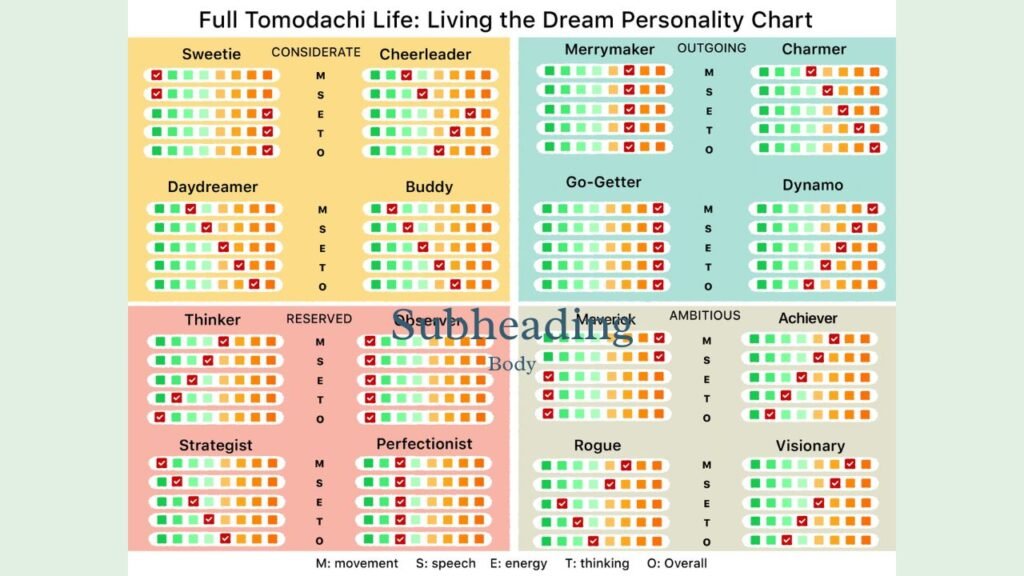
When creating a Mii, you can adjust several personality characteristics. Four of them determine the Mii’s core personality:
- Movement
- Speech
- Energy
- Thinking
The game presents these characteristics as scales, allowing you to make a Mii slower or quicker, more polite or direct, calmer or more expressive, and so on.
The Overall option is different. Current guides agree that it does not determine which of the 16 core personality types your Mii receives.
This means you do not need to treat every personality slider as equally important when trying to reproduce a specific type.
Movement
Movement controls how quickly or slowly the Mii tends to behave and move.
The scale generally runs between:
Slow → Quick
A slower setting can contribute to calmer personality combinations, while a quicker setting is associated with more energetic or active combinations.
Speech
Speech controls the style of the Mii’s communication.
The scale generally moves between:
Polite → Honest/Direct
A more direct setting can contribute to personalities that are straightforward or assertive, while polite settings appear more frequently among considerate and reserved combinations.
Energy
Energy represents how flat or expressive the Mii’s behavior is.
The scale can be understood roughly as:
Flat → Varied/Intense
Higher-energy combinations appear throughout the Outgoing and Considerate groups, while flatter combinations are common among Reserved and some Ambitious personalities.
Thinking
Thinking helps determine whether the Mii leans toward a more serious or relaxed approach.
The scale can be understood as:
Serious → Chill/Relaxed
Serious combinations occur prominently in the Reserved and Ambitious groups, while relaxed combinations are common among Considerate and Outgoing types.
All 16 Tomodachi Life Personality Types
Considerate Personalities
The Considerate group is called Easy-Going in some regions. These personalities generally represent friendly, supportive, relaxed, or positive behavior. The Tomodachi Life personality chart includes four Considerate personality types, each with its own combination of traits and behavior. Nintendo Life describes this group as particularly friendly, with personalities associated with dreaming, smiling, and putting friends first.
Sweetie / Softie
Sweetie is the US name, while Softie is used in some other regions.
This personality sits toward the gentle side of the chart. It is a useful choice when you want a Mii that feels warm, soft-spoken, and friendly.
Typical characteristics include:
- Polite speech
- Slower movement
- Higher energy expression
- Relaxed thinking
- Friendly behavior
If you are creating a Mii intended to feel particularly kind or gentle, Sweetie is one of the personality types to consider.
Cheerleader / Optimist
Cheerleader is the US name, while Optimist is used in other regions.
This personality combines a more active style with positive energy.
It generally fits a Mii that you want to portray as:
- Positive
- Encouraging
- Energetic
- Friendly
- Expressive
According to the Tomodachi Life personality chart, Cheerleader uses quicker movement compared with slower Considerate personalities while retaining the group’s more polite and relaxed characteristics.
Buddy / Carer
Buddy is the US name and Carer is used in other versions.
As the name suggests, this personality fits a friendly and supportive character.
Its general configuration emphasizes:
- Slow movement
- Polite speech
- Stronger expression
- Relaxed thinking
It can work particularly well for a Mii that you imagine as dependable, caring, or easy to get along with.
Daydreamer / Dreamer
Daydreamer is the US name, while Dreamer appears in other regions.
This personality occupies a more balanced position within the Considerate group.
It is useful when you want a Mii that does not lean heavily toward either extreme of the personality scales.
Outgoing Personalities
According to the Tomodachi Life personality chart, the Outgoing group includes four personality types that generally represent active, social, and expressive Mii characters.
The Outgoing group is called Energetic in some regions. These Miis tend to have more active and expressive personalities. Nintendo Life describes them as passionate, active, and willing to participate in activities around the island.
Charmer
Charmer keeps the same name across the US and other listed regions.
This personality combines a slower movement style with direct speech and high expression.
A Charmer can therefore fit a Mii that you want to feel:
- Social
- Expressive
- Confident in conversation
- Friendly
- Noticeable without necessarily being extremely fast-moving
Go-Getter / Adventurer
Go-Getter is the US name, while Adventurer is used in other regions.
This personality has a more active configuration and is a natural fit for an adventurous or energetic character.
It emphasizes:
- Quick movement
- Strong expression
- A more active personality
- A balanced approach to thinking
If you are creating a Mii who is supposed to be constantly doing something, this is one of the more fitting personality options.
Merrymaker / Bubbly
Merrymaker is the US name, while Bubbly is used in other versions.
This is another balanced Outgoing personality.
It is useful when you want a character that feels:
- Cheerful
- Social
- Energetic
- Playful
- Balanced
Dynamo / Hot-Blooded
Dynamo is the US name and Hot-Blooded is used in some other regions.
This personality is associated with quick movement, direct speech, and a flatter energy setting than some of the other Outgoing types.
That combination creates a different flavor of energetic personality rather than simply making every Outgoing Mii identical.
Reserved Personalities
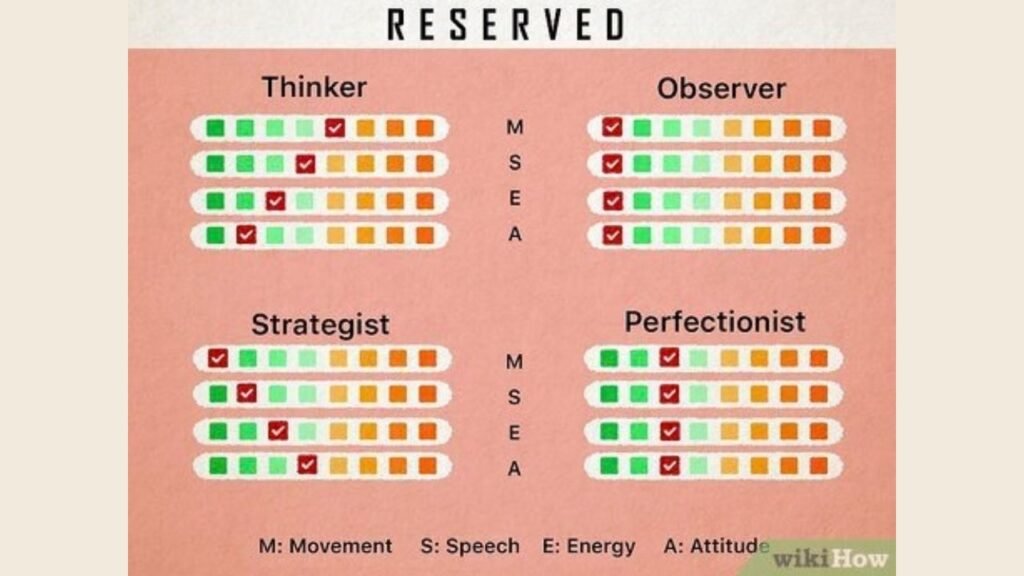
The Tomodachi Life personality chart includes four Reserved personality types, which generally suit Mii characters that are quieter, thoughtful, and more reserved. The Reserved group represents the quieter side of the personality chart. These Miis are generally more cautious, thoughtful, creative, or introverted.
Observer / Introvert
Observer is the US name, while Introvert is used in other regions.
This personality is one of the clearest choices if you want a quiet Mii.
Its general characteristics include:
- Slow movement
- Polite speech
- Flat energy
- More measured behavior
The name Observer also reflects the type of character this configuration is intended to represent: someone who is less outwardly energetic and more reserved.
Perfectionist
Perfectionist uses the same name in the referenced US and regional naming systems.
This personality sits closer to the middle of several scales while remaining part of the Reserved group.
It can suit a character who is intended to be:
- Careful
- Methodical
- Balanced
- Quietly focused
Strategist / Patient
Strategist is the US name, while Patient appears in other regions.
This personality combines slower movement and polite speech with stronger expression and a serious thinking style.
It is therefore more thoughtful and deliberate than an extremely outgoing Mii.
Thinker
Thinker retains the same name across the relevant versions.
This personality is another reserved option, emphasizing:
- Polite speech
- Flat energy
- Serious thinking
- More measured behavior
It works well for a Mii designed to feel quiet, analytical, or reflective.
Ambitious Personalities
The Ambitious group is called Confident in some regions.
Nintendo Life describes these Miis as more direct and focused on getting things done correctly.
Achiever / Busy Bee
Achiever is the US name, while Busy Bee is used in other regions.
This personality combines direct communication with a more active expression.
It can fit a Mii that you want to portray as:
- Goal-oriented
- Productive
- Direct
- Focused
- Serious
Visionary / Leader
Visionary is the US name, while Leader appears in other regions.
This personality is one of the more assertive combinations in the chart.
It uses quick movement and direct speech alongside strong expression and serious thinking.
That makes it suitable when creating a Mii who is supposed to come across as decisive or leadership-oriented.
Rogue / Individualist
Rogue is the US name, while Individualist is used in other regions.
This personality has a more restrained energy setting but retains the Ambitious group’s direct and serious character.
It can fit a Mii that you want to portray as independent rather than highly social.
Maverick / Headstrong
Maverick is the US name, while Headstrong appears in other regions.
This personality uses quick movement with a serious thinking style and a flatter energy configuration.
It represents a more forceful and independent character within the Ambitious group.
Tomodachi Life Personality Chart: Quick Reference
Here is a compact version you can use when creating Miis:
| US Personality | Other Regional Name | Group | General Style |
|---|---|---|---|
| Sweetie | Softie | Considerate | Gentle and friendly |
| Cheerleader | Optimist | Considerate | Positive and expressive |
| Buddy | Carer | Considerate | Supportive and friendly |
| Daydreamer | Dreamer | Considerate | Balanced and dreamy |
| Charmer | Charmer | Outgoing | Social and expressive |
| Go-Getter | Adventurer | Outgoing | Active and adventurous |
| Merrymaker | Bubbly | Outgoing | Cheerful and playful |
| Dynamo | Hot-Blooded | Outgoing | Energetic and intense |
| Strategist | Patient | Reserved | Thoughtful and deliberate |
| Perfectionist | Perfectionist | Reserved | Careful and focused |
| Observer | Introvert | Reserved | Quiet and observant |
| Thinker | Thinker | Reserved | Serious and reflective |
| Achiever | Busy Bee | Ambitious | Goal-oriented and direct |
| Visionary | Leader | Ambitious | Assertive and leadership-focused |
| Rogue | Individualist | Ambitious | Independent and serious |
| Maverick | Headstrong | Ambitious | Forceful and independent |
How to Get a Specific Personality
If you want a particular personality, start by deciding what kind of Mii you are trying to create.
For example:
Want a quiet Mii?
Look toward the Reserved group, particularly Observer, Thinker, Strategist, or Perfectionist.
Want a highly social Mii?
Look at the Outgoing group, including Charmer, Go-Getter, Merrymaker, and Dynamo.
Want a friendly and relaxed Mii?
The Considerate group is the natural place to start.
Want a direct or determined Mii?
The Ambitious group contains the more assertive personality combinations.
From there, adjust the four relevant personality traits during Mii creation.
One useful detail is that you do not necessarily need one exact slider combination for every personality. Current guides note that slightly different values can still produce the same personality type.
This is why copying a single set of slider positions from a chart is not always the only way to reach the desired result.
Does the Overall Slider Affect Personality?
No. The Overall setting does not determine your Mii’s core personality type.
The personality calculation is based on the four relevant characteristics:
- Movement
- Speech
- Energy
- Thinking
Both Nintendo Life and Pocket Tactics specifically identify Overall as something that does not affect the personality result.
That means you can choose the Overall setting based on how you want the character to feel without worrying that it will unexpectedly move the Mii into another personality category.
What Do Personality Types Actually Change?
Personality is not simply a label displayed on your Mii’s profile.
Current guides report that personality influences how Miis behave and react around the island. This can include their attitudes, reactions, interactions, and some of their physical behavior. Personality is also associated with the color of a Mii’s house or apartment. The Tomodachi Life personality chart helps explain how different personality types can influence the way Mii characters behave, react, and interact throughout the game.
This matters because the personality system helps give different Miis distinct behavior instead of making every island resident feel identical.
Nintendo describes Tomodachi Life: Living the Dream as a game centered around creating Mii characters, getting to know them, and watching them interact and come to life on the island.
Personality is therefore part of the game’s broader character-creation system.
Can You Change a Mii’s Personality Later?
If you are using the Tomodachi Life personality chart to adjust a character, you can change a Mii’s personality even after the character has already been created.
Yes. You are not permanently locked into the personality selected when the Mii is first created.
According to Nintendo Life’s current guide, you can edit a Mii and select the Personality Type option to change the relevant personality characteristics.
This is particularly useful if the personality you initially selected does not match the character you had in mind.
You also do not need to recreate the entire Mii from scratch simply because you want a different personality.
Are the Tomodachi Life Personalities the Same as the 3DS Version?
The Tomodachi Life personality chart closely follows the 16-type personality system associated with the original Nintendo 3DS version, although some details and naming can vary between versions. Current reporting indicates that the personality system in Tomodachi Life: Living the Dream corresponds closely with the established 16-type structure from the original 3DS game. Nintendo Life reports that the Switch game’s personality types correlate with those available in the 3DS version, while community-compiled data has been used to document the underlying values.
However, it is useful to distinguish documented game behavior from fan-created calculators and exact formulas.
Nintendo’s official product information confirms the Switch game and its Mii-focused character system, but the detailed slider formulas used by online personality charts are largely documented by guides and community research rather than presented as a complete official Nintendo formula table.
So if you use an online calculator or detailed slider chart, treat the exact values as community-documented game information rather than an official Nintendo-published formula.
Why Do Different Personality Charts Look Different?
If you compare two Tomodachi Life personality charts online, you may notice differences.
The most common reasons are:
Regional naming
US and UK/PAL versions can use different names for the same personality.
For example:
- Sweetie → Softie
- Buddy → Carer
- Cheerleader → Optimist
- Go-Getter → Adventurer
- Achiever → Busy Bee
- Visionary → Leader
- Rogue → Individualist
- Maverick → Headstrong
These are naming differences rather than additional personality types.
Different slider descriptions
Some guides describe the scales using slightly different words. For example, one guide may use Direct, while another uses Honest.
The underlying idea is the same: the player is choosing where the Mii falls on a personality-related scale.
Different chart formats
Some guides present the information as a 4×4 chart, while others list each personality separately with recommended slider positions.
The format may look different even when the underlying 16 personality types are the same.
A Simple Way to Choose the Right Personality
Using the Tomodachi Life personality chart makes it easier to choose a personality that matches the kind of Mii character you want to create. Instead of trying to memorize all 16 types, think about the character you want first.
If the character is kind and supportive
Start with Considerate.
Possible choices include:
- Sweetie
- Cheerleader
- Buddy
- Daydreamer
If the character is energetic and social
Start with Outgoing.
Possible choices include:
- Charmer
- Go-Getter
- Merrymaker
- Dynamo
If the character is quiet and thoughtful
Start with Reserved.
Possible choices include:
- Observer
- Perfectionist
- Strategist
- Thinker
If the character is driven and direct
Start with Ambitious.
Possible choices include:
- Achiever
- Visionary
- Rogue
- Maverick
This approach is usually easier than trying to memorize the entire personality chart before creating a Mii.
Frequently Asked Questions
How many personality types are in Tomodachi Life?
There are 16 personality types in Tomodachi Life: Living the Dream. They are divided into four main groups, with four personality types in each group.
What are the four Tomodachi Life personality groups?
The four groups are Considerate, Outgoing, Reserved, and Ambitious in the US naming system. Some regions use Easy-Going, Energetic, Reserved, and Confident for the corresponding groups.
What determines a Mii’s personality?
The Tomodachi Life personality chart is based on four main traits that determine which personality type a Mii receives. The four main characteristics used to determine the core personality are Movement, Speech, Energy, and Thinking. The Overall setting does not determine the personality type.
Can I choose my Mii’s personality?
Yes. When creating or editing a Mii, you can adjust the personality characteristics to produce the type you want. Current guides also document recommended combinations for reaching specific personalities.
Can you change a Mii’s personality after creating it?
Yes. You can edit the Mii and change its personality settings later.
Does the Overall slider change personality?
In the Tomodachi Life personality chart, the Overall slider is separate from the four traits that determine a Mii’s core personality. No. Current guides report that the Overall setting does not affect the core personality result. The four relevant characteristics are Movement, Speech, Energy, and Thinking.
Are the US and UK personality names different?
Some are. For example, Sweetie is called Softie in some other regions, while Achiever may appear as Busy Bee. These regional names refer to corresponding personality types.
Are the personalities the same as the original Tomodachi Life?
The Tomodachi Life personality chart uses the same 16 core personality types associated with the original Tomodachi Life game, making it easier to compare the personality system across versions. Current guides report that the Switch game’s personality system corresponds with the 16 personality types found in the original 3DS game.
Conclusion
The Tomodachi Life personality chart is essentially a quick reference for understanding the game’s 16 Mii personality types. The personalities are divided into four groups—Considerate, Outgoing, Reserved, and Ambitious—with four types in each group.
When creating a Mii, focus on Movement, Speech, Energy, and Thinking rather than the Overall setting. Once you understand what each group represents, choosing a personality becomes much easier.
The most useful approach is to decide what kind of character you want first and then use the personality chart to select the appropriate combination. If you change your mind later, you can edit the Mii’s personality rather than starting the character over.
Because regional versions can use different names, checking both US and UK/PAL names can also prevent confusion when comparing personality charts or guides online.