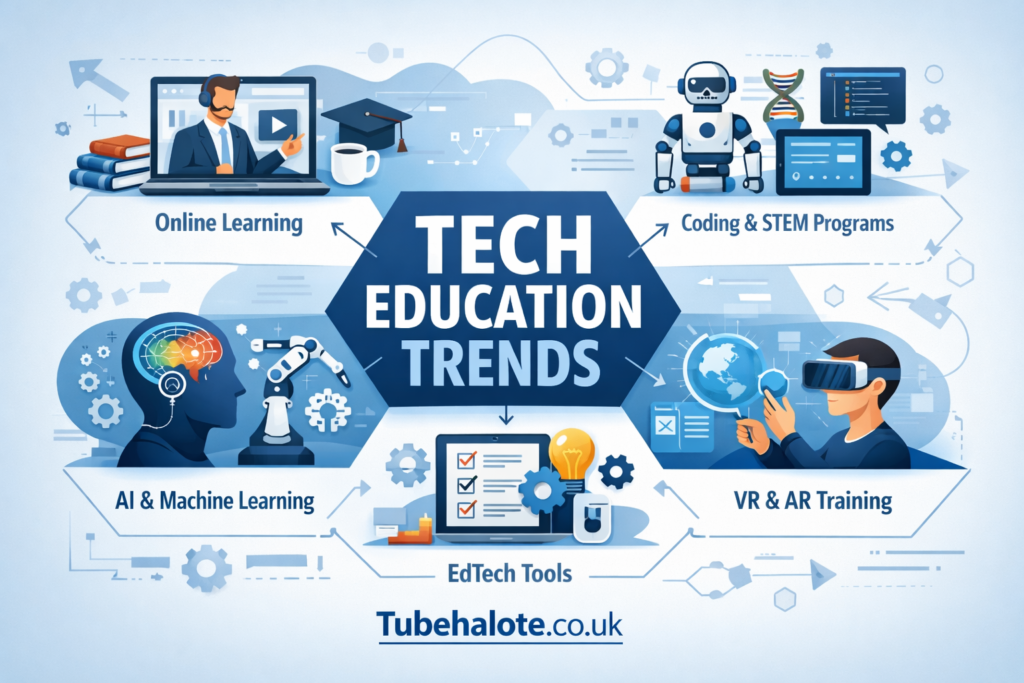

Droven IO tech education trends represent a major transformation in how education systems are evolving in the modern digital era. In 2026, learning is no longer limited to traditional classrooms or static textbooks. Instead, it is powered by artificial intelligence, cloud systems, and intelligent platforms that adapt to each learner’s needs, making education more flexible, accessible, and personalized across the globe.
The importance of Droven IO tech education trends lies in their ability to bridge the gap between technology and knowledge delivery. These trends highlight how institutions are shifting toward smarter ecosystems where data, automation, and immersive tools redefine how students learn. This transformation is not only improving learning outcomes but also preparing students for future digital economies.
Droven IO tech education trends are also reshaping teacher roles and institutional strategies. Educators are becoming facilitators of knowledge rather than just information providers, while schools and universities are adopting AI-based tools to enhance engagement. As a result, education is becoming more dynamic, interactive, and globally connected than ever before.
Another major impact of Droven IO tech education trends is accessibility. Students from remote areas can now access high-quality education through digital platforms. This democratization of learning ensures that geography is no longer a barrier, allowing millions of learners to benefit from advanced educational technologies and global knowledge systems.
AI Driven Personalization in Modern Education Systems
Artificial intelligence is one of the strongest forces behind Droven IO tech education trends, especially in personalization. AI systems analyze student performance, learning speed, and engagement patterns to create customized learning paths. This ensures that each learner receives content tailored specifically to their strengths and weaknesses, improving understanding and retention significantly.
In 2026, AI-powered tutors and virtual assistants are becoming common in both schools and universities. These systems provide real-time feedback, answer questions instantly, and guide students through complex topics. Droven IO tech education trends highlight how AI is reducing dependency on traditional one-size-fits-all teaching methods and replacing them with adaptive learning models.
Another important development is automated content creation. AI tools can now generate quizzes, assignments, and even full lesson plans within seconds. This allows educators to focus more on mentoring and less on repetitive administrative tasks. The efficiency gained through this technology is transforming how educational institutions operate globally.
AI personalization also helps identify struggling students early. Predictive algorithms can detect learning gaps before they become major issues, allowing timely intervention. This proactive approach ensures better academic outcomes and supports continuous improvement in student performance across all levels of education.
Immersive Learning Through AR VR and Extended Reality Technologies
One of the most exciting aspects of Droven IO tech education trends is the rise of immersive learning technologies such as augmented reality, virtual reality, and extended reality. These tools allow students to experience lessons in interactive and realistic environments rather than simply reading or listening to lectures.
Virtual reality is being used to simulate complex scenarios such as science experiments, historical explorations, and medical training. Students can now enter fully digital environments where they can practice skills safely and effectively. This hands-on experience significantly improves understanding and engagement compared to traditional methods.
Augmented reality adds another layer of interactivity by overlaying digital information onto real-world environments. This makes learning more visual and engaging, especially in subjects like anatomy, engineering, and geography. Droven IO tech education trends show that AR is becoming a core component of modern curriculum design.
Gamification is also playing a key role in immersive education. By integrating game-like elements such as rewards, levels, and challenges, students are more motivated to participate actively in learning activities. This combination of entertainment and education is reshaping student engagement globally.
Smart Campuses Powered by IoT and Connected Systems
Smart campuses are a central part of Droven IO tech education trends, where Internet of Things technology connects various educational systems into a unified digital network. These campuses use sensors, smart devices, and automated systems to improve efficiency and learning environments.
Attendance tracking, security monitoring, and classroom management are now automated through IoT devices. This reduces administrative workload and increases operational efficiency. Students benefit from a smoother learning experience while institutions gain better control over resources and infrastructure.
Environmental optimization is another key feature of smart campuses. IoT systems can regulate lighting, temperature, and air quality to create comfortable learning environments. Droven IO tech education trends emphasize how such improvements directly enhance student concentration and performance.
Predictive analytics is also integrated into smart campuses. Institutions can analyze data to predict student performance, attendance issues, or even dropout risks. This allows educators to take early action and provide necessary support, ensuring better academic success rates across the board.
Microlearning and the Rise of Skill Based Education Models
Modern education is rapidly shifting from traditional degree-focused systems to skill-based learning, and Droven IO tech education trends strongly support this transition. Microlearning focuses on short, targeted lessons that help learners acquire specific skills quickly and efficiently.
Digital badges and micro-credentials are becoming widely accepted as proof of skills in the job market. Employers now value practical knowledge and hands-on expertise more than traditional academic degrees in many industries. This shift is changing the entire structure of global education systems.
Nanolearning is another emerging concept where information is delivered in extremely small, focused units. This approach improves retention and makes learning more manageable for busy professionals and students. Droven IO tech education trends highlight how this method aligns perfectly with fast-paced modern lifestyles.
Online platforms are playing a major role in promoting skill-based education. Learners can now access thousands of courses, tutorials, and certifications from anywhere in the world. This flexibility ensures continuous learning and career development without the limitations of traditional education systems.
Data Analytics and Predictive Learning Systems in Education
Data analytics is transforming education by providing deep insights into student behavior, performance, and engagement. Droven IO tech education trends emphasize how institutions are using big data to improve decision-making processes and learning outcomes.
Predictive learning systems help educators identify students who may be at risk of falling behind. By analyzing attendance, performance, and interaction data, these systems can suggest timely interventions. This ensures that no student is left behind in the learning process.
Personalized dashboards are becoming common tools for both students and teachers. These dashboards provide real-time updates on progress, strengths, and areas that need improvement. Droven IO tech education trends show that such tools significantly enhance transparency and accountability in education.
Curriculum development is also influenced by data analytics. Institutions can adjust teaching methods and course structures based on student performance data, ensuring more effective and relevant education delivery that aligns with industry demands.
Cybersecurity Ethics and Digital Safety in Modern Education
As education becomes more digital, cybersecurity has become a critical concern. Droven IO tech education trends highlight the importance of protecting sensitive student data and ensuring secure learning environments across all digital platforms.
Educational institutions are now investing heavily in cybersecurity systems to prevent data breaches and cyberattacks. This includes encryption technologies, secure authentication systems, and continuous monitoring of digital platforms to ensure safety and privacy.
Ethical concerns surrounding artificial intelligence are also gaining attention. Ensuring fairness, transparency, and bias-free algorithms is essential in maintaining trust in AI-based education systems. Droven IO tech education trends emphasize responsible use of technology in learning environments.
Low-bandwidth and offline-first solutions are being developed to ensure accessibility in regions with limited internet connectivity. This ensures that digital education remains inclusive and equitable for all students, regardless of their location or economic background.
Future Technologies Transforming Global Education Systems
The future of education is being shaped by emerging technologies such as blockchain, 5G, and robotics. Droven IO tech education trends show how these innovations are creating more secure, fast, and interactive learning ecosystems.
Blockchain technology is being used to create secure academic records and certificates. This prevents fraud and ensures that educational achievements are permanently verifiable across global platforms, improving trust in academic credentials.
5G connectivity is enabling faster and more stable online learning experiences. High-speed internet allows real-time interaction, video streaming, and immersive learning without delays, making digital education more effective and accessible.
Robotics and automation are also entering classrooms, providing interactive learning support and practical demonstrations. Droven IO tech education trends suggest that these technologies will play a major role in future skill development and technical training programs.
Conclusion on Droven IO Tech Education Trends and the Future of Learning
Droven IO tech education trends clearly show that education is undergoing a massive transformation driven by artificial intelligence, immersive technologies, and data-driven systems. These innovations are creating a more personalized, efficient, and globally connected learning environment.
The future of education will be shaped by continuous innovation and adaptation. Students and educators must embrace digital tools and smart systems to remain competitive in an evolving world. Droven IO tech education trends highlight the importance of lifelong learning in the digital age.
Ultimately, education is becoming more inclusive, flexible, and technology-driven. The integration of AI, AR, VR, and analytics ensures that learners receive high-quality education tailored to their needs. This marks a new era of intelligent learning systems worldwide.
Frequently Asked Questions about Droven IO Tech Education Trends
What are Droven IO tech education trends?
Droven IO tech education trends refer to modern developments in educational technology that focus on AI, digital learning systems, immersive tools, and data-driven education models shaping the future of global learning.
How does AI impact education in 2026?
AI enhances education by personalizing learning experiences, automating administrative tasks, providing real-time feedback, and helping educators identify student weaknesses early for better academic outcomes.
What role does VR and AR play in education?
VR and AR create immersive learning environments where students can experience simulations, interactive lessons, and real-world scenarios, improving engagement and understanding.
What is microlearning in modern education?
Microlearning is a skill-based approach that delivers short, focused lessons designed to help learners quickly understand and apply specific knowledge or skills.
Why is cybersecurity important in education?
Cybersecurity protects sensitive student data, ensures privacy, and prevents cyberattacks, making digital learning environments safe and trustworthy.
What is the future of education technology?
The future includes AI-powered systems, blockchain certification, 5G learning environments, and robotics, all contributing to smarter and more efficient education systems.